
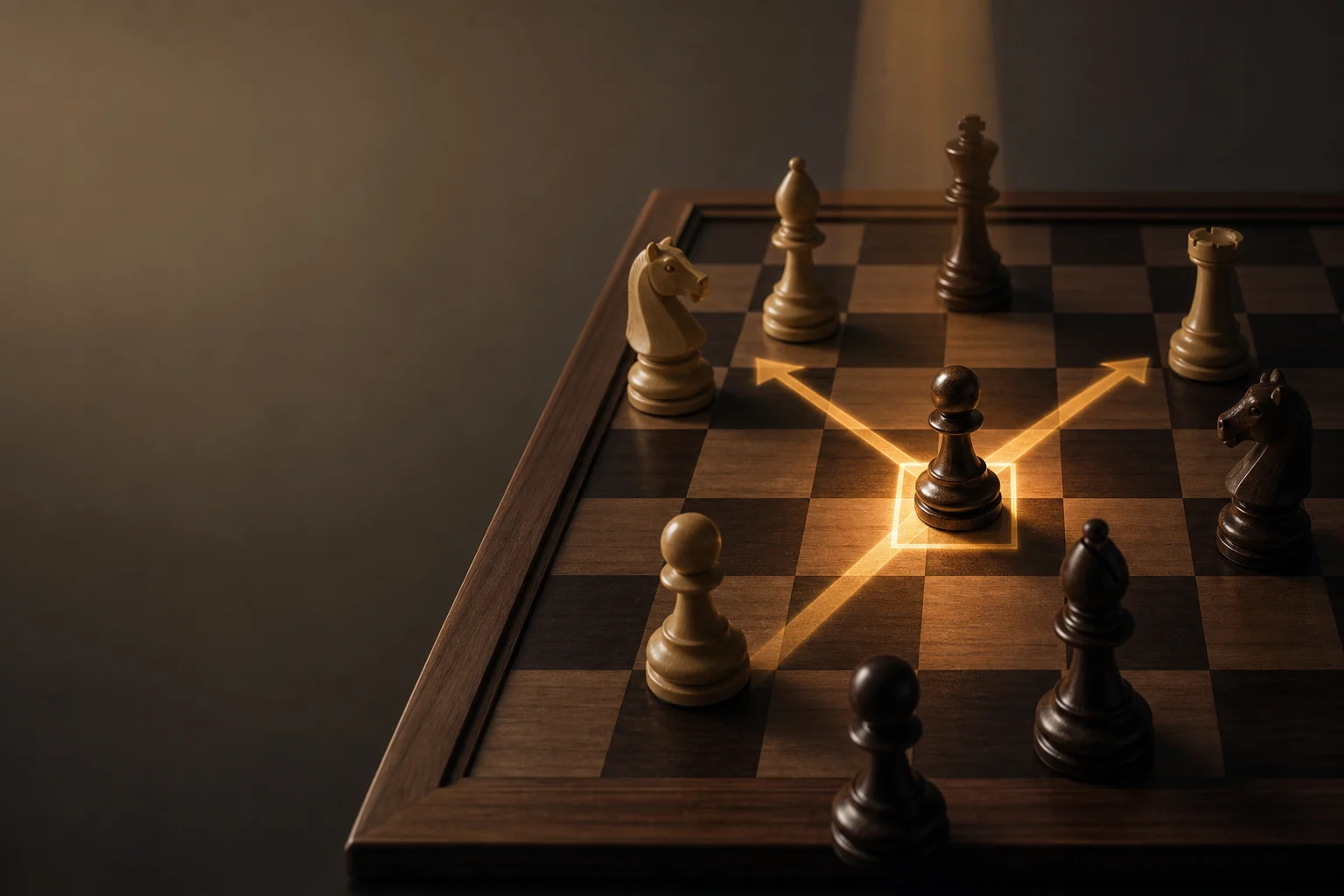
The short answer: a position is critical when choosing the right move or plan matters much more than usual. It may contain a forcing tactic, but it can also be quiet—a pawn break, exchange, retreat, or transition that determines what both sides will play for next.
A useful definition has two sides
Objectively critical positions have a narrow margin for error or several moves with very different consequences. One move may preserve equality while another allows a lasting weakness, a dangerous attack, or a technically difficult ending.
Personally critical positions expose a decision you did not know how to make. The engine evaluation may barely move, yet the position can still be valuable training material because you chose without a plan, spent too much time, or misunderstood the resulting structure.
Five signals that a position may be critical
- Forcing moves appearChecks, captures, direct threats, and tactical replies require concrete calculation.
- The decision is irreversibleA pawn break, exchange, sacrifice, or king move permanently changes the position.
- Tension cannot be maintainedThe centre, an attack, or a contested file is about to open or close.
- The game changes phaseThe opening becomes a middlegame, queens come off, or a technical ending begins.
- Your thinking changesYou feel uncertain, calculate much longer, reject several candidates, or play automatically in a position that deserved a pause.
During a game, one signal is enough to slow down. During review, combine these signals with your memory, clock usage, and the evaluation graph. The largest engine swing is useful evidence, but it is not the only place worth studying. The accuracy and evaluation guide explains why move grades need this context.
What to do when you recognize one
- Name what is changing.Is the issue king safety, material, pawn structure, piece activity, or a transition?
- Check the opponent's idea.Identify immediate threats before beginning your own plan.
- Calculate forcing moves first.List checks, captures, and direct threats for both sides.
- Add two serious candidates.Include a move that improves your worst piece or changes the structure.
- Compare resulting positions.Do not stop at the first move; ask which ending, structure, or attack you are choosing.
You do not need to calculate everything. You need enough calculation to distinguish the consequences of the candidates. If the choice remains unclear, prefer the move whose resulting position you understand and can play accurately.
Three exact examples of critical decisions
These training snapshots come from legal move sequences and show three different reasons a position becomes critical. They are not presented as complete opening recommendations; use them to practise recognizing what changed.
Example 1 · Structural commitment
The pawn move changes the long-term plan
Moves: 1.e4 c5 2.Nf3 d6 3.d4 cxd4 4.Nxd4 Nf6 5.Nc3 a6 6.Be3 e5
White must respond to the attack on the knight. More importantly, Black's ...e5 gains space and concedes the d5-square. Choosing the knight's retreat is also choosing how White will challenge that structure.
FEN: rnbqkb1r/1p3ppp/p2p1n2/4p3/3NP3/2N1B3/PPP2PPP/R2QKB1R w KQkq e6 0 7
Example 2 · Forcing calculation
King safety makes candidate order important
Moves: 1.e4 e5 2.Nf3 Nc6 3.Bc4 Nf6 4.Ng5 d5 5.exd5 Nxd5
White should not begin with a quiet developing move. The exposed f7-square and the uncastled black king make forcing candidates such as captures on f7 and checks the first calculation priority.
FEN: r1bqkb1r/ppp2ppp/2n5/3np1N1/2B5/8/PPPP1PPP/RNBQK2R w KQkq - 0 6
Example 3 · Phase transition
A queen trade changes the questions
Moves: 1.e4 e5 2.Nf3 Nc6 3.Bb5 a6 4.Bxc6 dxc6 5.O-O f6 6.d4 exd4 7.Nxd4 c5 8.Nb3
Black can consider ...Qxd1, leading to Rxd1 and a queenless position. Before exchanging, compare king activity, development, the bishop pair, and the queenside pawn structure. The trade is not automatically good or bad; it commits both sides to a different game.
FEN: r1bqkbnr/1pp3pp/p4p2/2p5/4P3/1N6/PPP2PPP/RNBQ1RK1 b kq - 1 8
How to find critical positions after the game
Start without the engine. Replay the game and mark every position where you:
- spent much more time than usual;
- felt surprised by the opponent's move;
- changed your plan or considered an irreversible move;
- could not choose between two candidates;
- played quickly and regretted it immediately.
Then use engine analysis to test those moments and locate tactical swings you missed completely. A useful review usually produces a small set of positions, not a comment on every move. Use How to Find Critical Moments in Your Chess Games for the two-pass selection method, then follow the complete post-game analysis workflow.
A critical position is not the same as a blunder
| Critical position | Blunder |
|---|---|
| A decision point with unusually important consequences. | A move that causes a serious objective deterioration. |
| Exists before the move is chosen. | Can only be identified after a move is played. |
| May be tactical, strategic, or technical. | Describes the quality of one move. |
| Can lead to several playable outcomes. | Usually gives the opponent a concrete opportunity. |
This distinction matters for training. If you study only blunders, you learn what failed. If you also study critical positions, you improve the decision process that comes before the result.
Frequently asked questions
How many critical positions are there in a chess game?
There is no fixed number. A quiet game may contain only a few, while a sharp game can present repeated forcing decisions. For practical review, focus on the small set that best explains the result or your thinking.
Can a quiet position be critical?
Yes. A quiet-looking pawn move, exchange, or piece retreat can permanently determine the structure and plan. Consequences matter more than visual drama.
Should I spend more time in every critical position?
Usually, but time is also a resource. Recognize the signal, define the decision, and calculate the most forcing candidates first. This is more efficient than calculating many unrelated moves.